

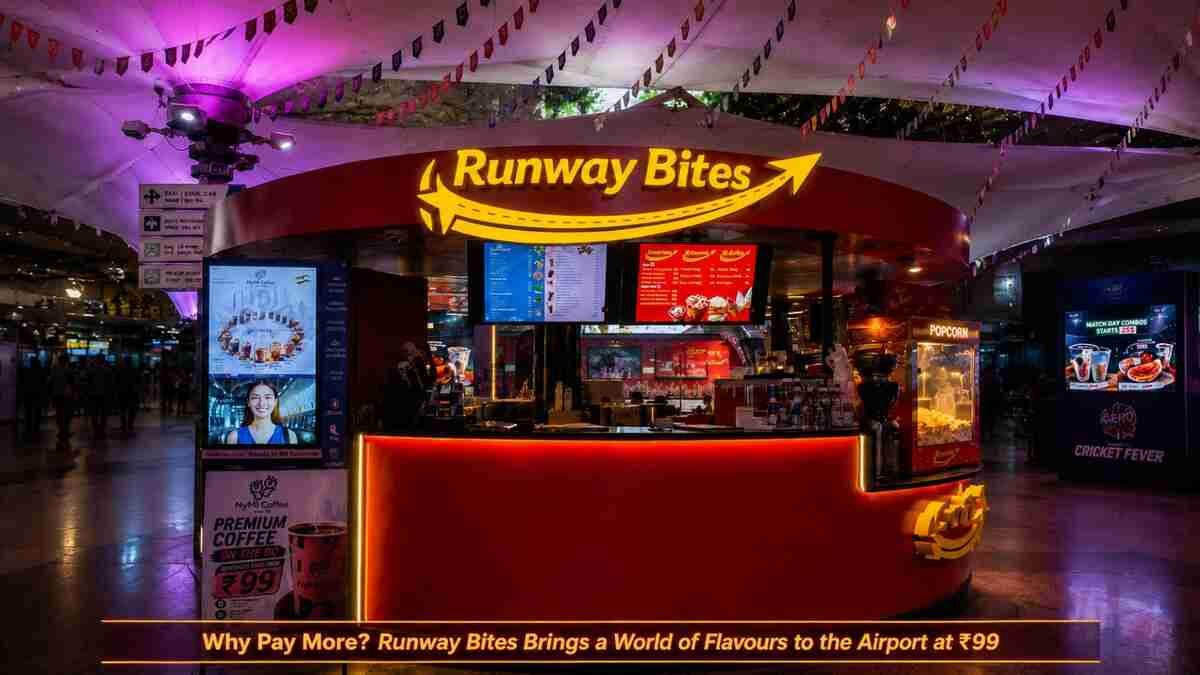
There is a particular kind of hunger that belongs only to airports. It strikes somewhere between the security check and the boarding gate — urgent, inconvenient, and almost always poorly timed. The terminal café queue stretches past the duty-free perfumes, the sandwich counter has run out of everything worth eating, and the departure board is already flashing a final call. For millions of passengers every year, this is not an occasional inconvenience. It is the airport dining experience as they know it.
Runway Bites, a new food concept making its presence felt across airport terminals, was built with precisely this problem in mind.
Designed as a 360-degree kiosk, the brand operates on a deceptively simple premise: that every side of the counter is a service point. Unlike traditional food stalls where customers funnel into a single line, Runway Bites allows access from all directions, breaking the bottleneck that forms during peak travel hours. The result is a structure that absorbs crowd pressure rather than amplifying it — a meaningful engineering choice in environments where time is rarely a luxury.
Speed, in fact, is central to what Runway Bites offers. Most orders are fulfilled in under 80 seconds, a figure that may seem modest until one considers the logistical tangle of airport catering, where even a cup of coffee can take the better part of a boarding window. For a business traveller with a laptop bag on one shoulder and a boarding pass about to expire, that margin matters considerably.
The menu reflects a similar understanding of its audience. Runway Bites stocks a range of items designed to be carried, consumed, and finished without ceremony — fresh popcorn, veg puffs, Korean buns, cookies, and a selection of sandwiches sit alongside freshly brewed coffee, tea, and chilled juices. For those wanting something lighter, fresh salads offer a considered option. Conitto pizza and softy ice cream round out the offering with a touch of indulgence, recognising that not every airport stop is born of necessity. Sometimes, a traveller simply wants something that tastes good before a long flight.
What the menu avoids is perhaps as telling as what it includes. There are no elaborate plated dishes, no timed table service, nothing that demands the traveller sit down and settle in. Every item has been conceived around portability and ease — qualities that the airport environment demands but that food concepts have historically struggled to deliver without sacrificing quality.
The brand positions itself around three principles: speed, convenience, and quality. These are not uncommon claims in the quick-service industry, but Runway Bites situates them within a context that tests all three simultaneously. Airports are among the most demanding commercial environments for food operators — high footfall, irregular demand spikes, compressed service windows, and customers whose tolerance for delay is structurally limited by their travel schedules. That Runway Bites has chosen this environment as its proving ground, rather than a more forgiving high-street setting, speaks to a certain ambition in the concept.
The travellers it serves are a varied group. Business passengers on early morning connections, families navigating terminals with small children and oversized cabin bags, airline crew between rotations, students heading home for holidays, and international tourists still adjusting to a new time zone — all of them pass through the same pinch points in the terminal, and all of them carry some version of the same need: something decent to eat, quickly and without fuss.
The kiosk format, compact by design, slots into airport terminals without demanding significant floor space or extensive infrastructure. This allows it to be positioned close to where passengers actually are — near gates, beside security exits, or within the central concourse — rather than requiring a detour to a dedicated food court. In airports where walking distances between zones can run into hundreds of metres, proximity is not a trivial advantage.
There is a broader shift in passenger expectations that concepts like Runway Bites are responding to. Air travel in India, already among the fastest-growing aviation markets in the world, has brought with it a new generation of frequent flyers who are accustomed to quality and increasingly unwilling to accept the compromises that once defined airport dining. The rushed meal, the overpriced and underwhelming snack, the vending machine as the only available option after nine in the evening — these are experiences that travellers have largely stopped accepting with resignation.
Runway Bites does not position itself as a dining destination in the conventional sense. It makes no claim to redefine what food can be. What it does, with some precision, is address a specific and recurring failure in the airport experience: the gap between what travellers need and what has, until recently, been available to them.
In an environment where the smallest conveniences carry disproportionate weight, that gap is worth closing. And for the passenger standing at the boarding gate with eighty seconds to spare, a fresh coffee and a warm bun might be, for the moment, exactly enough.
Runway Bites operates across airport terminals as a 360-degree quick-service kiosk offering grab-and-go food and beverages for travellers.
For more details:
https://www.instagram.com/runway_bites_?igsh=M2I3dGhzYjlkbzI3

